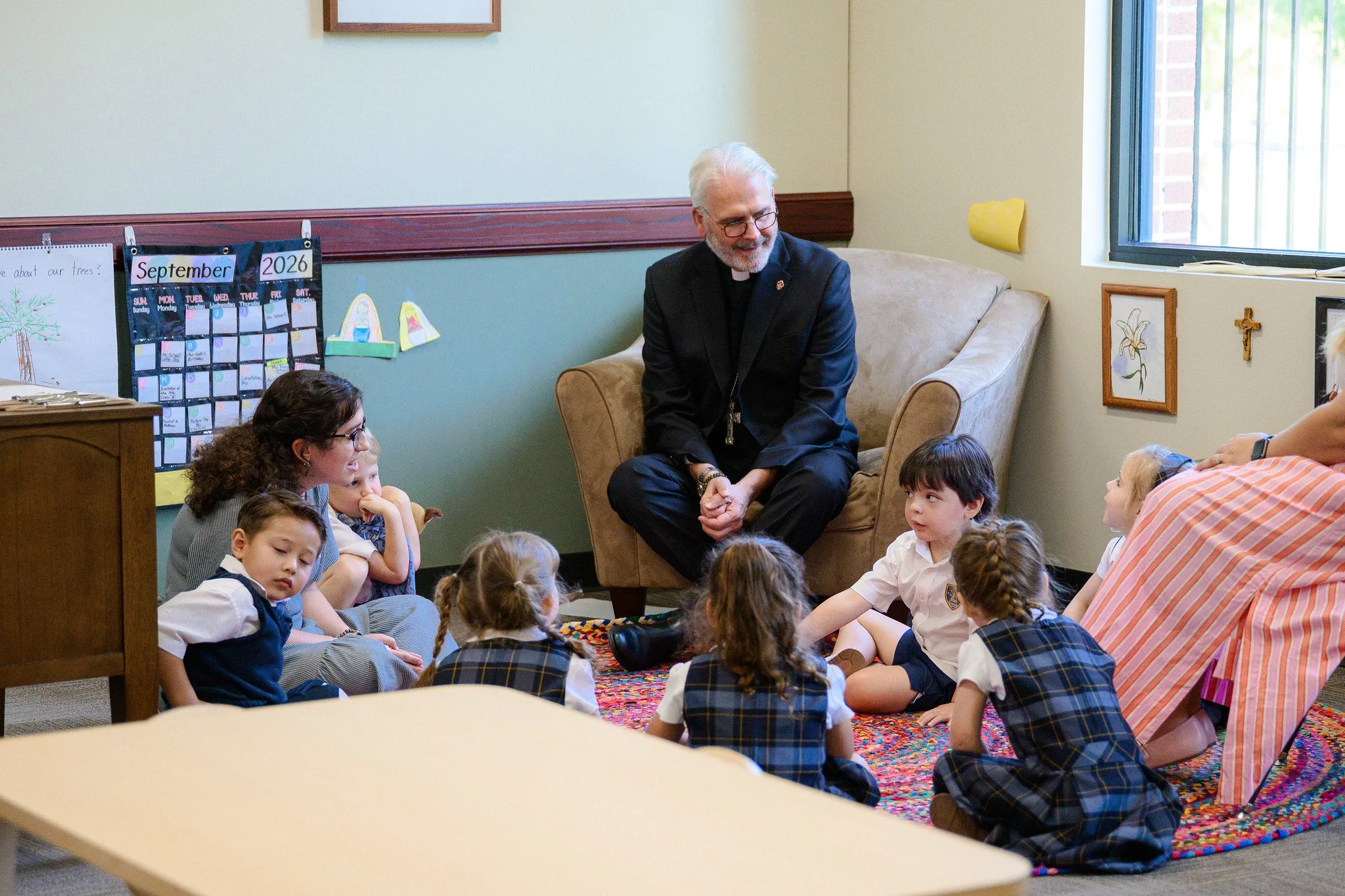
True education is about forming the soul and shaping young hearts to love what is true, to delight in what is beautiful, and to live according to what is good. At St. Monica Catholic Academy (SMCA), we do not seek to mass-produce efficient workers, reducing education to utility and measuring success by test scores, productivity, and career readiness; rather, we seek to cultivate saints.

From the moment children step onto our campus, they are immersed in an environment designed to awaken wonder and train the affections. Beauty is not an afterthought; it is woven into every part of our education. The architecture lifts the heart toward heaven. The sacred music forms the soul in harmony with divine order. The great books are not merely studied, but lived—introducing children to the heroes, saints, and thinkers who have shaped Christian civilization. Students do not simply learn about history; they walk in the footsteps of those who came before them. They do not merely read about virtue; they practice it through sacrifi ce, discipline, and joyful service.

At the heart of our education is the wisdom of St. Benedict: Ora et Labora—prayer and work. Each day begins with the highest act of worship: the Holy Sacrifi ce of the Mass. Our students do not simply attend Mass; they are formed by it. Immersed in the Church’s rich liturgical tradition, they learn to pray, to chant, and to worship with full hearts. Here, the rhythms of prayer and sacrament give order and meaning to our days, rooting each child in the unchanging truths of the Faith.

We form both the intellect and the will, the mind and the body. Students chant the timeless hymns of the Church, engage in deep discussions of philosophy and literature, and learn the dignity of labor through the manual arts. They work with their hands, tending the earth, crafting with care, and understanding that the world is not something to be exploited, but something to be cultivated and stewarded. The rhythms of work and prayer teach them patience, discipline, and humility—the habits that prepare them not only for a successful life, but for eternal life.

Young men are trained in true Christian chivalry—not the false bravado of the world, but the strength that comes from self-mastery, courage, and sacrifi cial leadership. Young women are formed in the grace of authentic femininity—not as an outdated ideal, but as a living expression of wisdom, beauty, and self-giving love. Both are called to something higher than the passing trends of culture; they are called to holiness, to heroism, to the fullness of life in Christ.

The world today forms children for comfort, mediocrity, and distraction. We form them for greatness. We do not prepare students merely for college or careers—we prepare them for eternity. If you long for an education that will teach your child not only how to think but how to live—an education that will shape not only the mind but the heart—then we invite you to join us at St. Monica Catholic Academy.

"Imagine a great cathedral being built—stone by stone, arch by arch, each chisel mark shaping it toward grandeur. This is the soul of a child in formation, and at the center of that great work is the Holy Sacrifice of the Mass. Just as medieval builders laid their foundations with prayer, so too does St. Monica’s shape each student with the Eucharist, forming them into living cathedrals fit to glorify God.”

~ Founding Member of St. Monica Catholic Academy

The Education of the Whole Child: The Mission of St. Monica Catholic Academy

A Sacred Partnership with Parents

We walk in partnership with parents, recognizing them as the primary educators and evangelizers of their children. We aim to protect and promote prayerful family time at home to enable parents and children to lovingly attend to the Lord and each other.

Together we cultivate a community where faith, wonder, and virtue flourish—not only within the school walls, but within homes and families, building up the Body of Christ.


Core Principles

  • At the heart of St. Monica Catholic Academy is the Holy Sacrifice of the Mass, which is not simply the center of our curriculum, but the center of life itself and the very foundation upon which all learning and formation rest. As St. John Vianney reminds us, "If we really understood the Mass, we would die of joy." It is in the liturgy that students encounter Christ most profoundly, where faith is not just taught but lived, and where they learn to order their entire lives to God.

    At the outset of each school day, the daily Mass immerses students in the beauty of the Church’s liturgical traditions. Through Gregorian chant, sacred hymns, and the prayers of the Church, they are formed in reverence, silence, and true participation in the mystery of the Eucharist. The Mass is not an accessory to our mission—it is its source and summit, the wellspring of all intellectual and moral formation.

    In addition to the Mass, students are shaped by a robust liturgical life, with opportunities for Eucharistic adoration, confession, and communal prayer of the Divine Offi ce. The rhythms of the liturgical year permeate the school’s culture, with feast days, processions, and devotions that align students’ hearts to the seasons of the Church. In this way, our students come to understand that Catholicism is not merely an academic subject, but a lived reality—one that touches every lesson we teach, every act of service, every pursuit of truth.

  • A truly Catholic education is one that forms souls, not just minds—one that pursues Truth, Goodness, and Beauty with unwavering dedication. These transcendentals are not abstract ideals, nor are they confi ned to theology or philosophy classrooms; they permeate every subject, every conversation, every moment of formation. A school that orients itself toward them does not merely educate—it transforms, shaping students who carry their faith, their wonder, and their love for wisdom into every aspect of life.

    Education is not about the accumulation of facts but about the ordering of the soul—awakening in students a longing for truth, a delight in goodness, and a sensitivity to beauty. As the Integrated Humanities Program (IHP) described it, “Nascantur in admiratione”—let them be born in wonder. A school that fosters this wonder instills in students not only a love for learning but a love for life itself, forming them into men and women who remain faithful, thoughtful, and attuned to God’s presence in the world long after they leave the classroom.

  • A true education must do more than sharpen the intellect—it must shape the heart. As Aristotle wisely said, “Educating the mind without educating the heart is no education at all.” Knowledge without virtue is powerless; it may produce clever individuals, but it will not produce good and holy ones.

    To educate the heart is to train the affections, to cultivate humility, courage, and self-sacrifice, so that students not only know what is right but have the strength to live it. A school that forms both mind and heart does not simply produce students who think well—it produces souls who love well, who serve well, and who seek Heaven above all else.

    Without this formation, education is incomplete. A student may master mathematics, philosophy, and science, but if his heart is unformed, he may use knowledge selfishly, seeing truth as something to be manipulated rather than something to be served. But when the heart is rightly ordered, the mind becomes an instrument of wisdom rather than mere intelligence, a tool for holiness rather than ambition.

    At St. Monica’s, we educate not for success alone, but for sainthood. For it is not the brightest minds, but the purest hearts, that truly change the world.

  • In a world that mistakes distraction for happiness and indulgence for joy, a truly Catholic education must teach students where real joy is found—n communion with God. As Joseph Pieper warns, “Man cannot live without joy; therefore, when he is deprived of true spiritual joy, he must become addicted to carnal pleasures.” Without the deep, abiding joy that comes from a well-ordered soul, the world offers only counterfeits—fleeting pleasures, shallow entertainments, and endless pursuits of self-gratification that leave the heart empty.

    A school that cultivates this true, spiritual joy forms students who are free—not enslaved to entertainment, to praise, or to the distractions of the age, but anchored in the things

    that endure. Such students do not seek to escape reality but to engage it fully, with clarity, courage, and purpose. At St. Monica Catholic Academy, we do not shield children from hardship—we teach them to embrace it with joy. For the soul that loves what is true, what is good, and what is beautiful, even sacrifice becomes a song, and the pursuit of holiness a path of joy.

  • Beauty is not an ornament to education—it is essential to the formation of the soul. As St. John Paul II reminds us in his Letter to Artists, “Beauty will save the world.” A truly Catholic education immerses students in beautiful architecture, sacred music, great literature, and the natural world, awakening their capacity for wonder and drawing their hearts toward God.

    Beauty also shapes discernment. As one educator wisely noted, “We immerse our students in beautiful music daily—Bach, Beethoven, and others—not just so they will recognize beautiful music, but so they will recognize ugly music when they hear it after they leave.” A school that prioritizes beauty forms students who are not only attuned to harmony and excellence, but who love what is truly good and reject what is false. In this way, beauty does not merely delight—it transforms, ordering the soul toward truth, virtue, and faith.

  • Schools shaped by the Benedictine tradition possess a distinctive strength: They order the life of students around prayer and work. The daily rhythm of study is woven seamlessly into the rhythm of prayer, fostering a deep familiarity with the sacred. By beginning and structuring the day with prayer—whether through the Divine Office, sacred hymns, or the Holy Sacrifice of the Mass—students learn that their intellectual pursuits are not separate from their spiritual lives but are an extension of them. This structure instills discipline, nurtures a love for the liturgy, and cultivates an awareness of God's presence in all things.

    Beyond its structured rhythm of work and prayer, the Benedictine model offers a unique approach to learning—a poetic mode of knowledge. Dr. James Taylor, in Poetic Knowledge: The Recovery of Education, describes this as an immersive, intuitive, and experiential encounter with reality. It is knowledge that does not begin with analysis or dissection but with love and wonder. Before a student can reason well, he must first be moved by the sheer beauty of what is before him.

    This approach to learning cultivates a love of wisdom by engaging both the intellect and the heart—allowing students to first perceive and delight in truth before being asked to

    articulate it rationally. A school that embraces this model forms the whole person, where education is not merely an intellectual exercise but a path to holiness, teaching students to see all things as pointing back to God.

    Integral to this formation are the manual arts. These are not merely practical skills but essential elements of a well-ordered education.

  • A true education must immerse students in the reality of life, which means it must provide “training in the immediate or naked contact with sensible reality,” as Dennis Quinn defines “gymnastic.” This training can take many forms, from ample time in nature and reinforcement of bodily self-control in the classroom at the grammar stage through a disciplined approach to athletics in the logic stage to a more explicit embrace of the redemptive meaning of suffering and the worth of traditional practices like fasting and feasting in the rhetoric stage.

    One of the most effective ways to achieve this is through the manual arts. Engaging in age-appropriate manual arts teaches students discipline and an appreciation for the material world as an extension of God’s creation. Working with one’s hands fosters a humility that intellectual pursuits alone cannot cultivate. As St. Benedict teaches, physical work is sanctifying when done in a spirit of devotion and service.

    By incorporating the manual arts into the school’s curriculum, students will develop not only practical skills but also a deep sense of stewardship, responsibility, and gratitude. This engagement with reality counteracts the growing detachment of modern life, where digital distractions often sever children from the tangible world. Teaching students to work with their hands reinforces a balanced, incarnational approach to education—one that recognizes the dignity of labor and its role in shaping both character and intellect.

  • Literature is not merely a subject of study—it is a force that forms culture, shapes imagination, and molds the soul. As John Senior observed, “Literature is the ox of culture, its beast of burden. Without it, we have no means of bearing culture.” The great books are more than words on a page; they carry the weight of civilization, passing down wisdom from one generation to the next.

    A truly Catholic education immerses students in stories that teach courage, sacrifice, honor, and virtue—not as abstract ideals, but as lived realities. Through epic poetry, sacred Scripture, and the timeless works of the Western tradition, students encounter heroes who struggle, persevere, and triumph, learning what it means to be fully human

    and fully alive. These stories do not remain within the walls of a school; they are carried home, enriching families, deepening conversations, and restoring a culture that has forgotten its own soul.

    A school that forms the imagination through great literature does more than teach—it transforms, igniting a love of truth and beauty that endures beyond the classroom.

  • Music is not merely ornamental; it is a force that shapes the soul. It is more than entertainment, more than a subject to be studied; it is a language that speaks to the heart, a discipline that forms the mind, and a prayer that lifts the soul to God. Joseph Pieper observed, “Music is a hearing with the heart and soul as much as with the ears.” The rhythms, melodies, and harmonies we internalize do more than please the senses—they train us to recognize order, beauty, and the divine.

    A truly Catholic education understands that music is formative. Schools that integrate sacred music, Gregorian chant, and the masterworks of Western civilization into their daily life do not merely create skilled musicians—they create ordered souls. Just as the Benedictines wove music into the rhythm of their monastic life, so too must a school seeking to shape virtue and inspire holiness. C.S. Lewis reminds us, “Music and silence—these are the two things that cannot be found in Hell.” Music instills both joy and discipline, deepening a student’s capacity for prayer, contemplation, and wonder. A school that understands the power of music understands the power of formation.

  • The formation of a child's imagination is foundational to their intellectual, moral, and spiritual development. In a classical Catholic liberal arts school, this formation is not incidental but central to the cultivation of wisdom and virtue. A well-formed sacramental imagination allows children to engage with truth, goodness, and beauty—not merely as abstract concepts but as living realities that shape their souls.

    Through exposure to great literature, sacred art, traditional hymns, and the rhythms of the natural world, children develop a moral vision that enables them to recognize and love what is true. Without this grounding, they are left vulnerable to the shallow and disordered influences of modern culture, which often stifles imagination through materialism, utilitarianism, and digital distractions.

    By immersing students in the great stories and symbols of Western civilization—particularly those rooted in the Faith—we give them a foundation for understanding the deeper truths of Sacred Scripture and the lives of the saints. A well-formed sacramental imagination is a gateway to contemplation, helping children to see the world sacramentally, as a place where all creation speaks of God. In fostering this capacity, we prepare them not only to think deeply but to love rightly, directing their affections toward the highest things.

  • At the heart of Christian education is piety — a humble reverence for God, for parents, and for the treasures of faith and culture handed down to us. As St. Augustine writes in The City of God, “Virtue cannot exist save for those that have piety.” Without piety, virtue becomes hollow, reduced to mere behavior or civic habit; with piety, it becomes a living orientation of the soul toward God and neighbor.

    This spirit of piety shapes what the ancients called paideia — the formation of the whole person through the guiding influence of culture. Education is not merely the transmission of ideas or skills; it is the enculturation of children into the fullness of Christian life. It is not enough to hand on isolated truths or moral principles; we are called to pass on an entire culture — faith and worship, manners and memory, music and art, story and song — so they may grow not only in knowledge, but in wisdom and love.

    Such formation gives children roots. It draws them into a living tradition, helping them understand not only what they believe, but why it is good, beautiful, and worth loving. To neglect this is to raise children as strangers to their own inheritance; to embrace it is to form souls ready to live, witness, and even suffer for the truth — with courage, joy, and hearts set on Heaven.

  • The art of chivalry is largely forgotten in modern education, yet it was once a defining feature of Western civilization. This school seeks to restore and cultivate true Christian chivalry—teaching young men to embody the virtues of knighthood, honor, and sacrifice, as exemplified in the Song of Roland and other great epics of the Christian tradition. Our young men will be called to a life of virtue, courage, and self-mastery, embracing their role as protectors of the weak and defenders of truth.

    For young women, the school will foster the cultivation of authentic feminine virtue, modeled on the virtues of Our Lady—purity, strength, wisdom, and devotion. In a world

    that seeks to obscure the beauty of femininity, this education will inspire young women to embrace their God-given dignity and calling with grace and confidence.

    Both boys and girls will receive an education that reinforces the complementary nature of their vocations, forming young men who are noble and self-sacrificing, and young women who are strong and nurturing—each prepared to take their place in the grand story of salvation history.

  • A truly thriving Catholic school is far more than a place of learning —it is a mission-driven community, where students, parents, and teachers walk together in the pursuit of truth, goodness, and beauty. At the heart of this community is the faculty, for a school is not merely a collection of classrooms but a faculty of friends —educators united in Christ, bound by shared faith, and committed to ongoing growth and formation.

    In such a community, education extends beyond textbooks and lectures; it is lived in the bonds of trust between teachers and students, in the camaraderie among faculty, and in the joyful traditions that unite families. This unity forms a culture of order, purpose, and joy, where learning is not just an individual pursuit but a shared journey of faith and reason.

    A school that builds true Christian community is one where faculty inspire by example; where students see teachers not only as teachers, but as mentors and friends; and where parents, students, and educators grow in holiness together.

  • In a world that seeks comfort, convenience, and ease, a truly Catholic education must teach that sacrifice is not a burden but a gift—a path to holiness, strength, and true fulfillment. Families today are not looking for what is easy; they are looking for what is true. The willingness to sacrifice for one’s faith, for one’s children, and for one’s community is the mark of a strong Catholic family—and the mark of a strong Catholic school.

    Education that demands nothing forms nothing. A school that fosters sacrifice and discipline—whether through rigorous academic expectations, the work of the hands in the manual arts, or participation in traditions like pilgrimage and fasting—does more than train minds; it builds souls that are resilient, courageous, and oriented toward God.

    It forms students who understand that comfort does not lead to greatness, and that the most worthwhile things in life come at a cost—but a cost worth paying.

    At St. Monica Catholic Academy, we do not prepare students for a life of ease—we prepare them for a life of purpose. Here, sacrifice is not seen as something to be avoided, but something to be embraced—the forge in which character is shaped, faith is strengthened, and hearts are prepared for the great adventure of holiness.

    At St. Monica’s, we do not simply educate children—we prepare them for eternity. If you seek a school where your child will not only learn, but be formed—where their mind, heart, and soul will be shaped toward holiness—then we invite you to join us. Let us build a school where children are not only taught, but transformed

    Education is not the work of schools alone—it is a sacred partnership with parents. At St. Monica’s, we invite families to share in our liturgical life, to celebrate feasts with us, and to walk together in the pursuit of holiness. A thriving Catholic school is more than an institution—it is a family of faith.

Contact us

Interested in enrolling and learning more information regarding St. Monica Catholic Academy? Click the black button and fill out the interest form and we will be in touch shortly. We can’t wait to hear from you!

Interested? Click Here to register your interest